

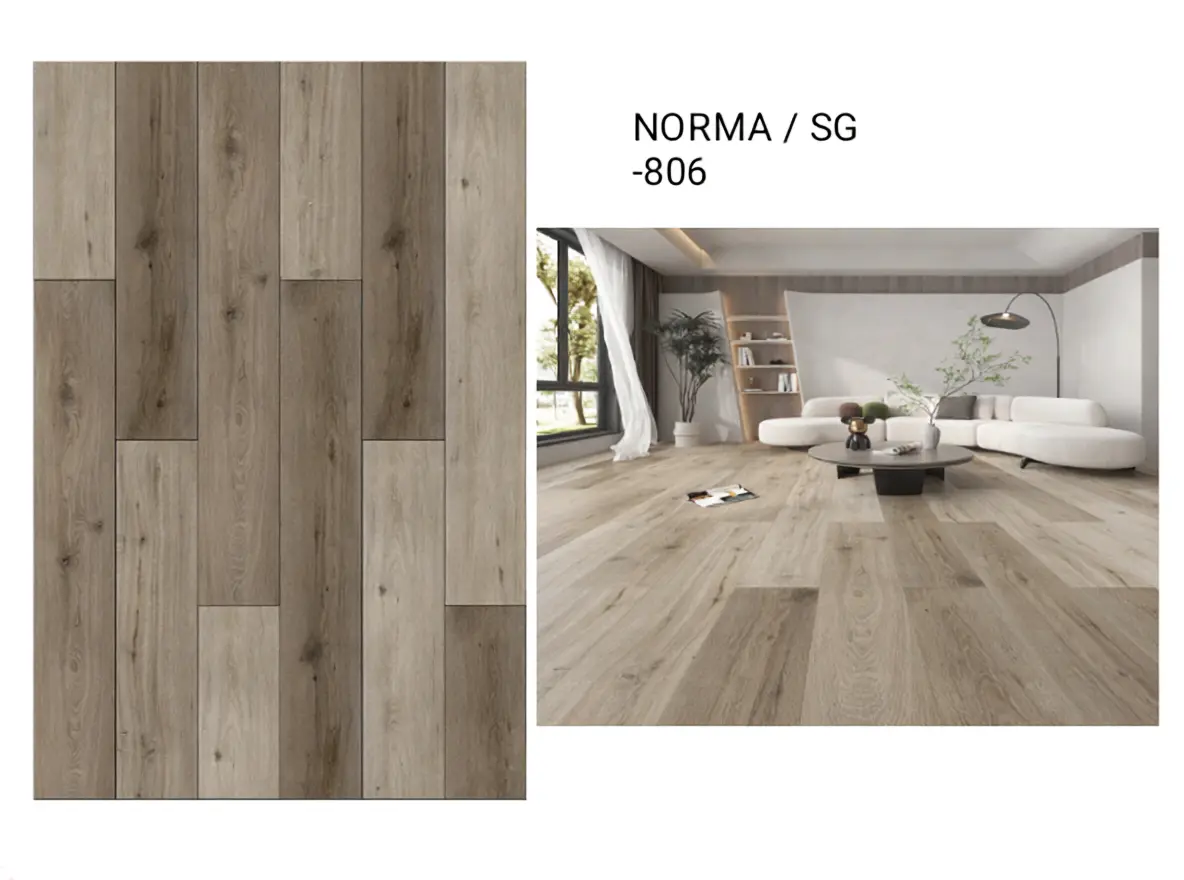
Description
Norma Floorway: Rigid Core Vinyl Built for a Climate That Swings
Ask anyone who has lived through a few Ontario winters what happened to their old floor, and the answer often involves gaps that appeared in January and closed again by June. Norma from the Floorway range is rigid core vinyl, a construction designed with exactly that annual cycle in mind.
The Twelve Month Cycle Your Floor Lives Through
In July the air in a Kitchener house can sit heavy and damp, and the whole building takes that moisture on. By February the furnace has been running for months, the air has dried right out, and indoor relative humidity can drop a long way below where it sat in summer. Every material in the house responds. Doors that stuck in August swing freely in the cold. Trim opens a hairline at the mitres. A floor is simply the largest continuous surface in the building, so whatever movement occurs is multiplied across every plank and every joint.
That is why a floor can look flawless in the showroom and still disappoint later. The question is not how a product looks on day one. The question is how much it changes between the wettest week of the year and the driest one.
Why a Rigid Core Copes Better
Vinyl plank is built as a printed decorative layer over a dense core with a protective wear surface on top. In rigid core vinyl, that middle layer is the part doing the structural work. It is dense and stiff, and unlike timber it does not draw in and release moisture through its thickness, so it is far less inclined to swell, shrink or cup as the air changes around it.
The practical result is dimensionally stable flooring: planks that hold their shape and keep their joints tight through the year. Dimensionally stable flooring is also quieter to live with, since joints that stay closed do not click or shift underfoot. This is one of the genuine reasons vinyl plank flooring has become so common in basements, additions and sunrooms, the places where seasonal swing is felt most sharply. Products of this type generally cope with a wide humidity range, though every product has its own limits, so the tolerances for Norma should be confirmed rather than assumed.
Giving the Material the Best Start
- Bring the boxes into the actual room and leave them flat for the recommended period, so the planks settle to the conditions they will live in
- Store them away from exterior walls, vents and direct sun while they acclimatise
- Have the heating or cooling running at normal settings before, during and after the installation, not switched on afterwards
- Leave the recommended expansion allowance at every wall, pipe and threshold
- Work a humidifier or dehumidifier towards a reasonably steady indoor range rather than letting the house drift to extremes
The last point does more good than people expect. Stable indoor humidity is kinder to your floor, your trim, your furniture and your own comfort, and it costs very little to manage once you own a simple hygrometer.
Checking the Specification for Your Rooms
Acclimatisation periods, subfloor moisture limits, underlay requirements and suitability for unheated or seasonally used spaces all vary between vinyl plank flooring products. Please confirm the specification, the install method and room suitability with the Petun Flooring team before you order, and consider professional installation, since correct expansion allowances are the single most common thing a well meaning first attempt gets wrong.
Lighting and screen settings never tell the whole story about how a plank will read in your own house, so examine the product photo closely and ask us for a sample to take home. Norma is ready for pickup in Kitchener and Cambridge, inventory is limited, and we are happy to sit down with your measurements and work out quantities, thresholds and a room by room plan.


Reviews
There are no reviews yet.