Description
Casing Two Step Backband: Finishing Windows and Completing the Package
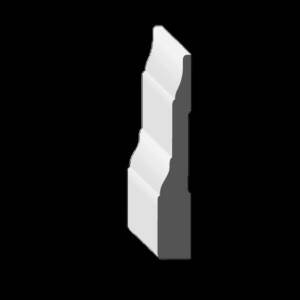
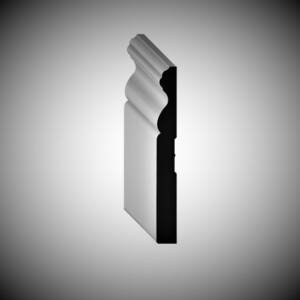
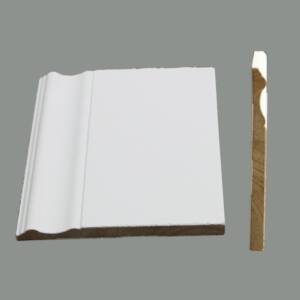
Windows are where trim decisions become obvious. A door is seen in passing, while a window is looked at for hours, framed by daylight and usually the focal point of the wall it sits in. The two step backband exists to give those openings a proper edge, at 1 inch thick by 3-1/4 inches wide in 8 foot lengths, wrapping the outer border of two step casing already installed.
Picture framed or stool and apron
There are two common ways to treat a window. A picture framed surround runs casing on all four sides, mitred at every corner, so the opening is bordered evenly like a painting. The traditional alternative sets a stool across the bottom, the horizontal ledge many people call a sill, with an apron running beneath it and the casing legs landing on the stool at either side.
A backband suits both. On a picture framed opening it carries continuously around all four sides and gives the frame a deliberate outer boundary. On a stool and apron build it wraps the head and the legs, and the apron below is scaled to sit comfortably with the added depth. Deciding which approach you want before ordering matters, because the two use different quantities of window casing.
Consistency across a whole floor
The strongest argument for a backband is what it does when repeated. One well finished window looks handsome. Every window and every door on a floor sharing the same build up looks designed. The eye registers the repetition without naming it, and rooms that were furnished quite differently begin to feel connected.
Ordering a full trim package at once is the way to protect that consistency. Casing, base and backband bought together mean a single profile family, a single primer, and none of the mismatch that appears when a house is trimmed in stages over several years. Where a renovation is happening room by room, it is still worth working out the whole floor first and collecting the trim package in one go.
Details worth settling early
Window openings often sit close to a return wall or beneath a ceiling line, so check that the extra projection has somewhere to land before you commit. Blinds and curtain hardware need attention too, since an inside mount blind must clear the depth of the surround and a bracket fixed to the casing sits further into the room once a backband is added. Where a run of backband ends without meeting anything, a mitred corner return closes it neatly.
These are primed mouldings, painted after installation in nearly every case, which allows the layers of the surround to be filled and sanded so the assembly reads as one piece.
Installation and confirmation
We recommend professional installation, and window work rewards it. Stools must be level, legs must land on them squarely, and the mitres of an outer border are the first thing anyone notices in the bright light a window provides. Confirm the profile, the material and the quantities with the Petun Flooring team before ordering, and tell us whether you are picture framing or building a stool and apron so the counts come out right.
Trim depth is hard to judge from a screen, and the daylight around a window is unlike any showroom light, so study the product image and ask to see a length in person before you decide. Pickup is available in Kitchener and Cambridge, trim inventory is limited, and shipping and financing can be arranged. Bring your window and door measurements to us and we will help you plan the whole floor at once.