

Two planks sit on the showroom counter. They look identical, they cost within a dollar of each other, and one of them is going to perform noticeably better in the room you have in mind. The sales tag says SPC vs WPC is a matter of preference, which is a polite way of avoiding a longer conversation.
It is not preference. The two cores behave differently under weight, under temperature swings, and under a dropped cast iron pan, and once that is clear the choice usually makes itself in about a minute.
SPC vs WPC at a glance
- SPC (stone plastic composite): limestone powder and PVC core, denser, better dent resistance and temperature stability.
- WPC (wood plastic composite): wood flour and a foaming agent, lighter, warmer and quieter underfoot.
- Both are waterproof at the plank level and installed pricing in Ontario sits in a similar $5 to $12 per sq ft band.
What the Letters Actually Mean
Both belong to the rigid core vinyl flooring family, which replaced the old flexible vinyl plank in most Canadian showrooms somewhere around 2018. The difference lives in the middle layer.
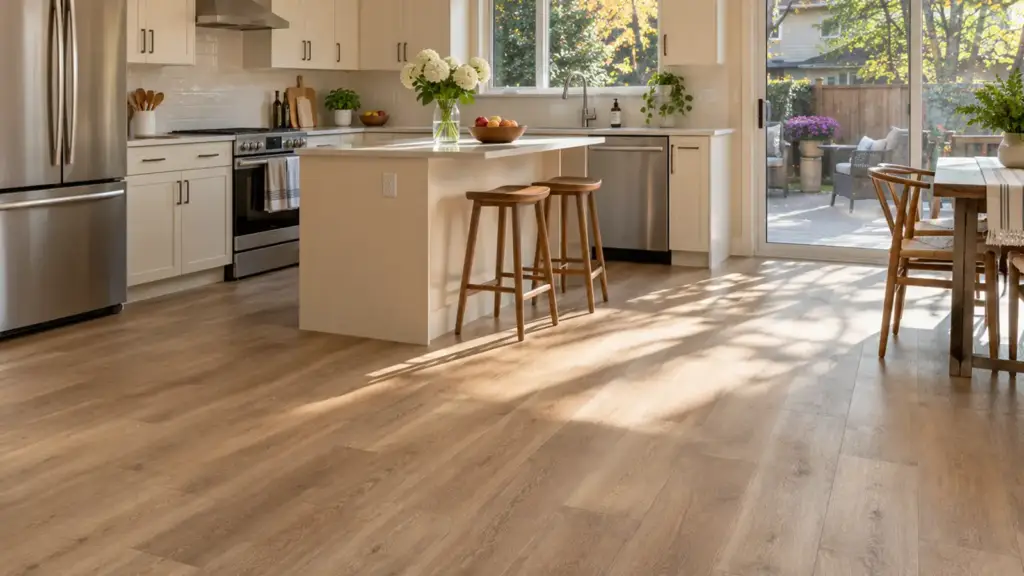
Stone plastic composite uses limestone powder blended with PVC. It is dense, heavy, and about as forgiving as a kitchen countertop. Wood plastic composite swaps that mineral filler for wood flour and a foaming agent, which produces a lighter plank with air trapped inside the core.
Neither core contains meaningful amounts of real wood, despite what wood plastic composite sounds like. The wood flour is essentially sawdust used as a filler, and it does not absorb water the way a laminate core does.
Where They Genuinely Differ
Denting and heavy loads
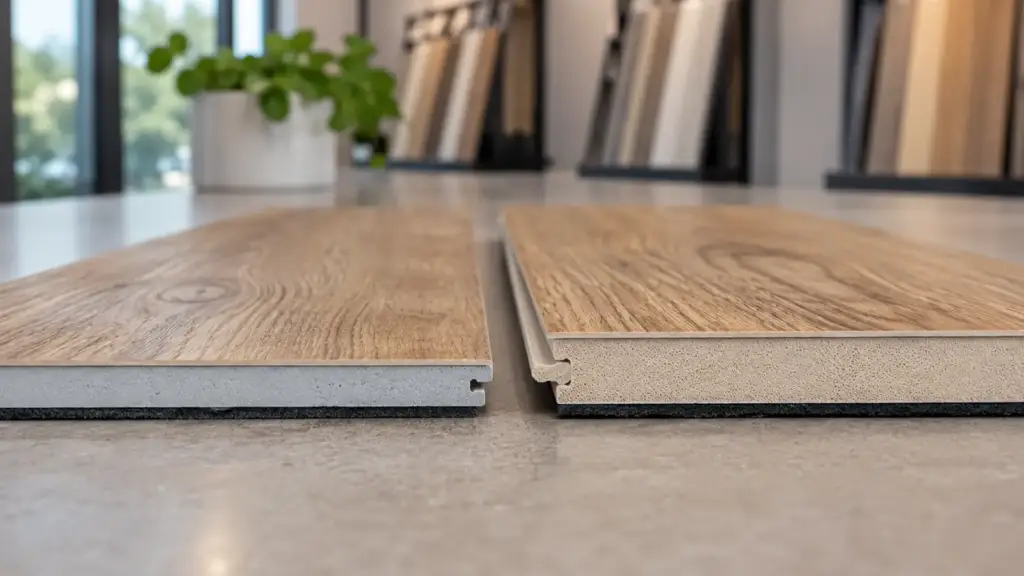
Density wins here and it is not close. Dent resistance in a stone core is significantly better, because there is nowhere for the material to compress. Fridge legs, piano wheels, a stiletto heel, the corner of a moved sofa, all of these leave marks in a foamed core that a stone core simply shrugs off. Dent resistance is the clearest practical gap between the two constructions.
Anyone with a heavy dining table or a home gym has a clear answer already.
Comfort and sound
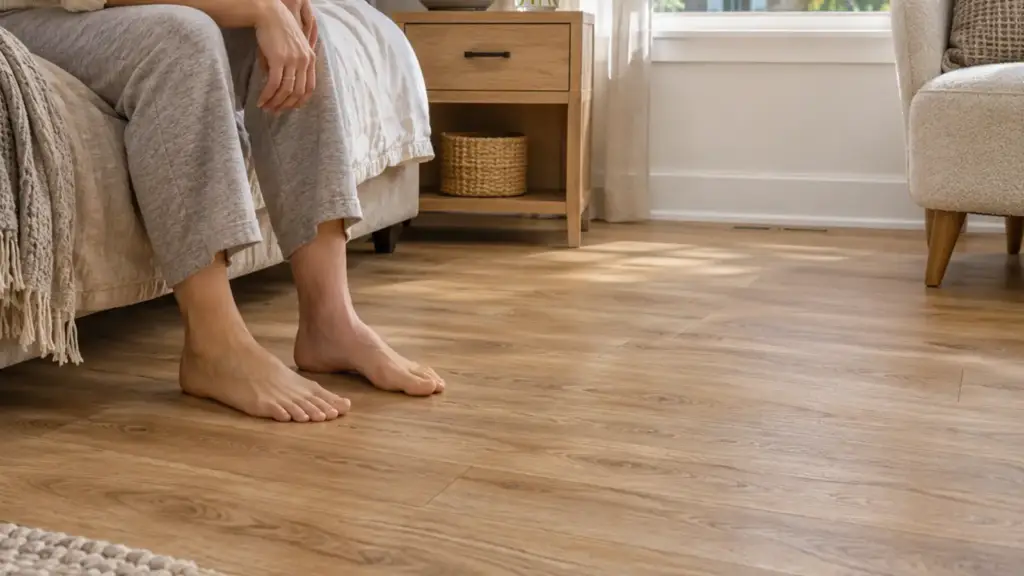
The foamed core wins this one just as decisively. It is warmer underfoot, quieter under a running child, and noticeably softer over a concrete slab. A stone core over a basement floor feels exactly like what it is, a hard plank on hard concrete, unless a good pad goes underneath it.
Most products now arrive with an attached underlay of cork or IXPE foam, which narrows the gap. It does not close it entirely, and an attached underlay never performs quite like a separate acoustic pad in a condo.
Temperature stability
This is the one that matters most in this country and gets discussed the least. A stone plastic composite core expands and contracts very little with temperature, which is why it is trusted in sunrooms, over radiant heat, and near patio doors that bake all afternoon. A foamed core moves more, and in a floating installation that movement has to go somewhere.
Expansion gaps at the wall stop being a technical nicety in those rooms. They become the only thing preventing a plank from lifting in August.
SPC vs WPC Comparison Table
| Feature | SPC (stone core) | WPC (foamed core) |
|---|---|---|
| Core material | Limestone powder blended with PVC | Wood flour, PVC and a foaming agent |
| Dent resistance | Significantly better under heavy loads | Fridge legs and heels can leave marks |
| Comfort and sound | Hard underfoot without a good pad | Warmer, softer and quieter |
| Temperature stability | Expands and contracts very little | Moves more with temperature |
| Handling | Heavier, harder on saw blades | Lighter, hides minor subfloor flaws slightly better |
| Best rooms | Basements, kitchens, sunrooms, rentals | Bedrooms, hallways, living rooms, condos |
Thickness, Wear Layer and the Numbers on the Box
Total plank thickness gets quoted constantly and means very little on its own. A six millimetre stone core will outperform an eight millimetre foamed core in almost every structural sense, so comparing total millimetres between the two categories is close to meaningless.
The number worth reading is the vinyl plank wear layer, measured in mils. Twelve mil suits a quiet bedroom. Twenty mil and up belongs in kitchens, entries and rental units. The vinyl plank wear layer governs how a floor ages far more than the core does, and it applies equally to both types.
A few honest comparisons when weighing SPC vs WPC on paper:
Stone cores are heavier to carry and harder on saw blades, which shows up as slightly higher labour on large jobs. Foamed cores hide minor subfloor imperfections a little better, though neither product excuses skipping preparation. And both are waterproof at the plank level, so that headline feature settles nothing at all between them.
Matching the Core to the Room
Basements and below grade spaces
Basement vinyl flooring is where stone cores dominate for good reason. Concrete slabs run cold, they can carry moisture from below, and they rarely hold a steady temperature through the year. A dimensionally stable core handles that better.
The comfort complaint about basement vinyl flooring is real though, and it is solved with a separate underpad rated for use over concrete rather than by switching cores.
Main floors and bedrooms
Foamed cores earn their place upstairs. Bedrooms, hallways and living rooms with normal furniture loads benefit from the quieter, softer feel, and the acoustic difference is noticeable in a condo where the neighbour below is listening whether they want to be or not.
Kitchens, sunrooms and rentals
Stone core again. Heavy appliances, direct sun through large windows, and tenants who will not be gentle all point the same direction.
Price, and Why It Barely Separates Them
Canadian pricing for both sits in a similar band. Installed costs for quality rigid core vinyl flooring generally run between five and twelve dollars per square foot in Ontario depending on wear layer, brand and site conditions, and the core type is rarely the reason one quote sits higher than another.
What does move the number is preparation. Rigid core vinyl flooring is unforgiving of a wavy substrate regardless of what fills the middle layer, and the levelling work is charged the same either way.
A Short Way to Decide
Stone core for hard use, heat, sunlight, basements and anywhere a floor has to be dimensionally boring. Foamed core for comfort, quiet, and rooms where feet matter more than furniture. That covers roughly ninety percent of real homes.
The rest comes down to what a specific collection looks like, since visual quality varies far more between brands than between core types. A beautifully embossed foamed plank will make a room look better than a flat, plasticky stone one, and no technical spec sheet captures that.
Worth asking any retailer for offcuts of both to take home. Put them on the floor of the room in question, stand on them in bare feet, drop something heavy from thirty centimetres, and the SPC vs WPC debate resolves itself faster than any brochure will manage. Petun Flooring and most reputable Ontario suppliers hand out samples without much argument, because they would rather have the conversation before installation than after.
SPC vs WPC: Quick Answers
Is SPC or WPC better for a basement?
SPC. A dimensionally stable stone core handles cold, variable concrete slabs better. The comfort issue is solved with a separate underpad rated for concrete, not by switching cores.
Is WPC flooring waterproof?
Yes. Both SPC and WPC are waterproof at the plank level. The wood flour in a WPC core is a filler and does not absorb water the way a laminate core does.
What vinyl plank wear layer should I choose?
Twelve mil suits a quiet bedroom. Twenty mil and up belongs in kitchens, entries and rental units, whichever core type you choose.
Does a thicker plank mean a better floor?
Not across categories. A 6 mm stone core outperforms an 8 mm foamed core in almost every structural sense, so the wear layer is the more useful number.
Want to try the barefoot and drop test yourself? Ask Petun Flooring for SPC and WPC samples to compare in the room you are planning.
